Stop reviewing with static flashcards. This suite gives your AP CSP students ten interactive, self-grading browser-based tools — all aligned to College Board exam objectives and ready to open on any device with no setup required.
What’s included:
Binary & Hex Converter Drill Timed or untimed flashcard-style drill for converting between decimal, binary, and hexadecimal. Six conversion types, three difficulty levels (4-bit through 8-bit), a visual bit-toggle helper, and streak tracking. Timed mode: 60 seconds — how many can you nail?
Vocabulary Flashcard Deck 60 AP CSP terms across all 6 units on tap-to-flip cards. Reveals definition, explanation, and example on the back. Filter by unit, shuffle, mark as Got It or Still Learning, and use Review Weak Only mode to drill just the cards that need work.
Creative Commons License Drill 20 scenario cards covering all 6 CC licenses (CC0 through CC BY-NC-ND). A quick-reference strip stays visible during the drill. Covers creator choices, user permission questions, and AP-exam-style tricky cases with detailed explanations after every answer.
Algorithm Sorting Visualizer Animated step-by-step visualization of bubble, selection, insertion, and merge sort. Color-coded bars (amber = comparing, red = swapping, teal = sorted), comparison and swap counters, step explanations, adjustable speed and array size. Manual step or auto-play.
Pseudocode Tracer 8 programs (easy to hard) that students step through line by line. The active line highlights in amber, a variable tracker shows live values, and an output panel builds as DISPLAY statements execute. Students predict output before stepping — correct/wrong revealed with a hint if wrong.
Pseudocode ↔ Python Translator Two modes: Reference (side-by-side comparison of all AP pseudocode constructs and Python equivalents) and Quiz (10 shuffled questions going both directions). Targets the 1-based indexing trap and = vs. == distinction directly.
Big-O Ranker 5 rounds of drag-and-drop complexity ranking from fastest to slowest. Starts with O(1)/O(n)/O(n²), adds binary search and merge sort, then a Name Mode round, and finishes with all six complexities. Green for correct position, red for wrong, one-line explanation after each check.
Fair Use Analyzer 8 real copyright scenarios walked through the four-factor test (Purpose, Nature, Amount, Market Effect). Students rate each factor as Favors / Neutral / Against, building a 12-point score that produces a verdict from Strong Fair Use to Not Fair Use. Per-factor explanations reveal the nuance.
IOC Scenario Sorter 20 real-world computing innovation effects classified in two steps: first Intended vs. Unintended, then Beneficial vs. Harmful. Swipe-style card animation, streak tracking, and scenarios covering GPS routing, facial recognition bias, encryption, social media, and more.
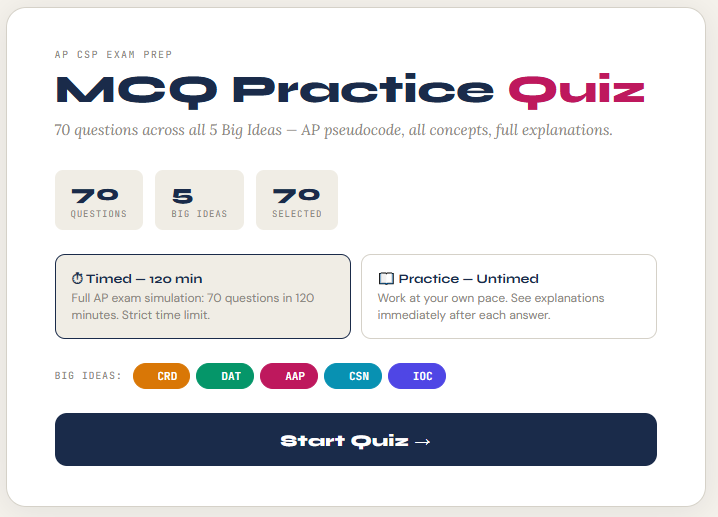
AP MCQ Practice Quiz 70 questions across all 5 Big Ideas in AP exam proportions, including AP pseudocode tracing questions. Timed mode (120 minutes) or untimed. Question grid sidebar, flag for review, jump-to-any-question navigation. After submission: score by Big Idea as a bar chart. Full per-question review with explanations.
All tools open in any browser. No login, no College Board account, no software required. Instant digital download.
College Board AP CSP Alignment:
| Big Idea | Code | Tools |
|---|---|---|
| Creative Development | CRD | Pseudocode Tracer, Pseudocode ↔ Python, MCQ Quiz |
| Data & Analysis | DAT | Binary & Hex Drill, Algorithm Visualizer, Big-O Ranker, MCQ Quiz |
| Algorithms & Programming | AAP | Pseudocode Tracer, Pseudocode ↔ Python, Big-O Ranker, MCQ Quiz |
| Computer Systems & Networks | CSN | MCQ Quiz, Vocabulary Deck |
| Impacts of Computing | IOC | Creative Commons Drill, Fair Use Analyzer, IOC Scenario Sorter, MCQ Quiz |
Also aligns to:
- College Board AP CSP Computational Thinking Practices — all 6
- CSTA Standards: 3A-AP-13, 3A-AP-17, 3A-DA-09, 3A-IC-24, 3A-IC-25, 3A-IC-26
- ISTE Standards: Computational Thinker, Digital Citizen
Reviews
There are no reviews yet.